IoT, AI and BIM architecture are three terms that mean very different things depending on where you sit in a practice.
If you are a project architect juggling a Stage 4 technical package, they can feel abstract and honestly a bit removed from the day to day.
If you are a director thinking about where the profession is heading, they are probably already on your agenda whether you invited them or not.
Either way, the conversation is happening. And it is worth being part of it.
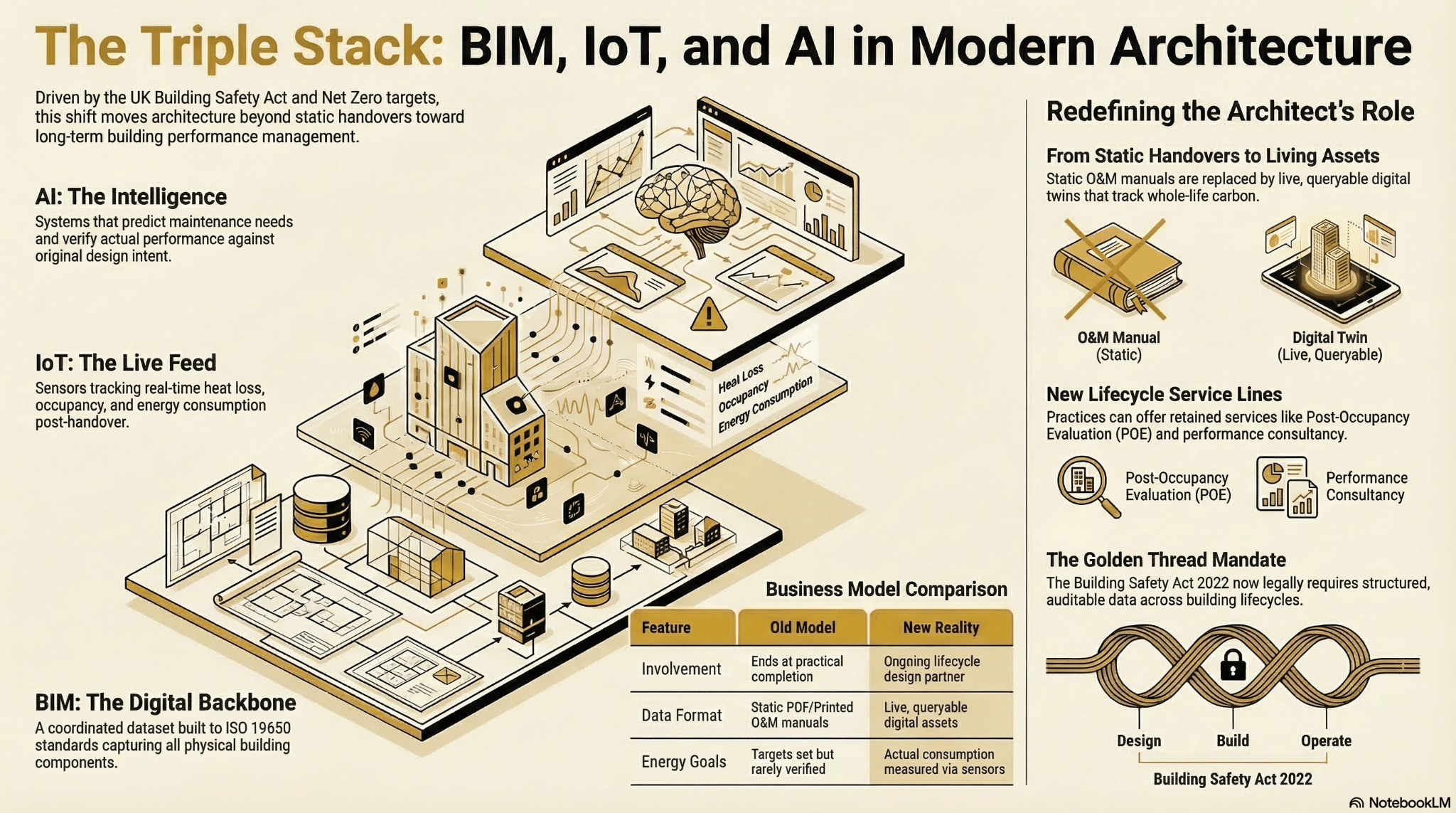
These three technologies are no longer developing in separate corners of the industry. They are coming together in ways that genuinely change what architects do and how buildings perform long after the keys are handed over.
Think about it this way.
You spend months, sometimes years, crafting a design. You fight for every detail through planning, through value engineering, through contractor queries.
And then the building opens, and most of that design intelligence quietly disappears into an Operations and Maintenance (O&M) manual that nobody reads.
The triple stack changes that story.
And whether you have been in practice for two years or twenty, understanding how it works is becoming as essential as knowing how to write a specification clause or coordinate a federated model.
The timing of this conversation is not accidental. Three things have landed at roughly the same time in the UK, creating a genuine inflection point for the profession.
BIM is no longer new territory.
Most UK practices are working to ISO 19650, the framework that replaced PAS 1192 and governs how building information is managed across a project.
The Building Safety Act 2022 has since made structured, auditable design data a legal requirement for higher-risk buildings, not simply best practice.
AI has become accessible overnight.
Tools that once needed a dedicated data science team are now embedded in software architects already use daily, from generative design assistants to automated clash detection and energy modelling aligned with Part L compliance.
IoT costs have dropped significantly.
Sensors that once felt like a premium specification are now affordable across commercial, residential and public sector projects, including schools and NHS facilities where lifecycle performance is tied to procurement requirements.
These three shifts arrived together rather than in sequence. That is what makes this moment different from previous PropTech waves.
The Golden Thread obligation under the Building Safety Act (the requirement to maintain a continuous, accurate and accessible record of design information across a building's entire lifecycle) is making the triple stack increasingly hard to sidestep.
For most of its history, architectural practice has followed a linear logic.
You design, you build, you hand over. The building then lives its life largely disconnected from the people who created it.
The problem is not the process itself.
It is what gets lost at the end of it.

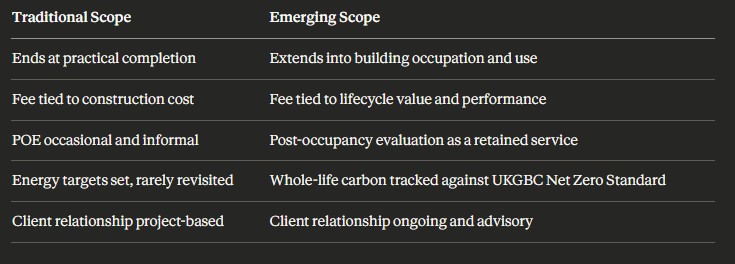
Think about what that right hand column actually represents.
It is not a technology upgrade. It is a completely different relationship between the architect, the building and the client.
One where your design thinking does not stop at practical completion but continues to inform how the building is used, managed and improved for years afterwards.
This is where it gets tangible.
Let us walk through how the three layers actually work together using a project type many UK practices know well — a Victorian office building being converted to residential use under permitted development or full planning consent.
The federated model is built to ISO 19650 standards, capturing the existing building fabric alongside the proposed design.
For a conversion project, this means the model holds everything from original masonry wall thicknesses to new MEP routes, all in one auditable and coordinated dataset.
Once the building is occupied, sensors feed real-time data back into the model. On a conversion project this is particularly valuable because existing fabric behaves unpredictably. The live feed might include:
This is where the data stops being noise and starts being useful.
AI works across the live feed to:
Together the three layers give everyone involved, the architect, the client, the building manager, a shared and continuously updated picture of how the building is actually performing rather than how it was assumed it would perform on paper.
Here is where the conversation gets really interesting.
Because the triple stack does not just change how buildings perform. It changes what architects are for.
The scope question is real and worth raising honestly.
If your practice is connected to a building's performance data post-handover, questions around professional liability, PI insurance and appointment scope will need revisiting.
The RIBA Standard Professional Services Contract is beginning to reflect this but most practices are still working it out.
The opportunity, however, is significant.
New service lines are already emerging in forward-thinking UK practices:
The practices building these service lines now are not just becoming better designers. They are becoming more valuable businesses with deeper, longer client relationships.
And for early-career architects, this is genuinely good news.
These are skills you can develop now, before they become standard expectation.
No useful conversation about technology in practice ends without acknowledging what actually gets in the way. And there is plenty that does.
Client readiness is still a genuine issue.
Many UK clients, particularly in the public sector, do not yet have the internal capability or appetite to use what the triple stack produces.
A local authority housing team or NHS estate manager receiving a live dashboard of building performance data is only useful if someone knows what to do with it.
Interoperability remains frustratingly fragmented.
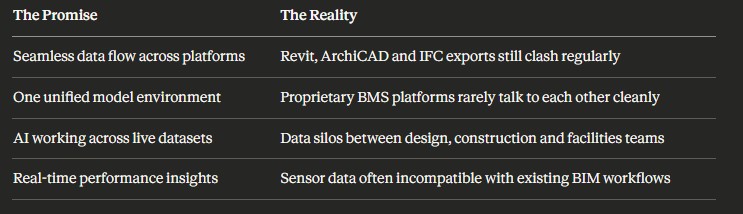
The skills gap is real but closeable.
Cost perception is still a blocker.
Upfront sensor infrastructure and digital twin setup can feel like an unjustifiable addition to an already stretched contingency.
Until clients see lifecycle savings evidenced on completed projects, the business case remains a hard sell in fee negotiations.
The good news is that none of these barriers are permanent.
They are the friction that comes with any meaningful shift in how a profession works.
The worst response to all of this is to wait until everything is figured out industry-wide. The best response is to start small, start smart and build from there.
Do not try to do everything at once.
Pick one project, one building type, one data stream and learn from it properly before scaling up. A single energy sub-metering pilot on a current project teaches you more than six months of CPD reading.
Bring in a specialist early, not late.
Get facilities management in the room at design stage.
This still feels radical in many UK practices but it is one of the highest-value things you can do. The people who will manage the building for the next thirty years have insights that no sensor can replace.
Use compliance as your business case.
Build your own literacy gradually.
You do not need to become a data scientist.
You need to understand enough to ask the right questions, specify the right systems and have the right conversations with your clients and consultants.
The triple stack is not a demand for architects to become technologists.
It is an invitation to work smarter, reduce abortive effort and build the kind of client relationships that generate repeat appointments rather than one-off commissions.
Practices that embed the BIM, IoT and AI workflow into how they operate will spend less time chasing information and more time adding value where it counts.
That translates directly into better productivity, stronger fee justification and a compelling story about what your practice actually delivers across a building's entire life.