.png)
Retrofit audits for architects represent one of the most accessible and immediately sellable services available right now.
With millions of UK homeowners under pressure to cut energy bills and improve ageing homes, architects are perfectly placed to offer paid retrofit audits as a standalone service — one that generates income quickly, builds client trust, and opens the door to larger commissions.
Energy costs in the UK have reshaped how homeowners think about their properties.
For many, the monthly bill is no longer background noise; it is a genuine financial burden that is prompting real decisions about insulation, heating systems, and long-term comfort.
That shift in mindset is creating a window of opportunity that architects are well positioned to step through.
Homeowners are not simply looking to spend money on improvements. They want clarity first.
Before committing to a new boiler, a loft conversion, or a full refurbishment, many want to understand what their home actually needs; in the right order, at the right cost, with a clear sense of return. That is precisely what a retrofit audit delivers.
The number of UK households looking for credible retrofit advice is rising steadily as energy costs remain high and government messaging around net zero intensifies.
A retrofit audit does not require a planning application, a contractor, or months of design work. It requires site knowledge, building expertise, and the ability to translate findings into practical recommendations.
Homeowners are cautious about large spending commitments. A well-priced audit gives them something concrete and useful without asking them to sign up for a major project immediately.
Unlike energy assessors or general contractors, architects carry a professional credibility that reassures clients; particularly when the advice involves their most valuable asset.
This is not simply a sustainability conversation. It is a business opportunity with real, immediate commercial legs and it is available right now, without a significant change in how most practices operate.
Anyone who has spoken to a homeowner recently knows the conversation has changed. Energy bills, draughty rooms, and ageing boilers are front of mind — and people want answers, not just sympathy.
Homeowners are not rushing to spend.
They want clarity first; what does my home actually need, in what order, and is it worth it?
That is exactly what a retrofit audit answers.
Why does this matter for your practice?
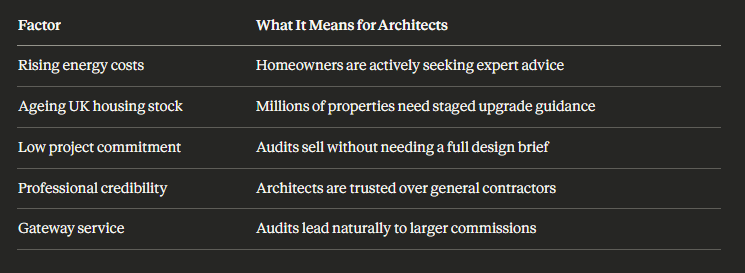
This is a genuine, immediate revenue opportunity and most practices can offer it without changing much at all.
This is where architects have a real edge.
Unlike a basic energy assessment, a retrofit audit carried out by an architect brings genuine building knowledge to the table; the kind that actually helps homeowners make smart decisions.
A solid retrofit audit should cover:
The key distinction worth making with clients is straightforward — this is not a full design commission. It is focused, expert advice with a clear deliverable. That makes it much easier to scope, price, and sell.

Retrofit audits are not just good for clients; they make strong business sense for practices of any size.
Here are five (5) reasons smart practices are already making them work:
The difference between a one-off audit and a genuinely scalable service often comes down to systems. Without the right tools, every audit feels like starting from scratch and that eats into your margin fast.
Here is how the right productivity stack makes the difference:
The practices getting the most from retrofit audits are not necessarily the largest. They are the ones with the tightest, most repeatable workflows.
Not every homeowner is the right fit and knowing your ideal client saves time and sharpens your marketing considerably.
Here are the client profiles worth targeting:
The good news is that retrofit audits are not a hard sell — the demand is already there. The job is simply making sure the right people know you offer it.
Here are the most tested and proven strategies:
The timing is genuinely hard to ignore.
Energy costs remain high, the UK's housing stock is not getting any younger, and homeowners are actively looking for trusted professionals to guide them.
Retrofit audits for architects represent a rare alignment; a real client need, a service that fits naturally within existing expertise, and a commercial opportunity that requires very little setup to launch.
The practices that move early will build reputation, referral networks, and recurring revenue while others are still thinking about it.
Retrofit audits are not a trend to watch from a distance.
They are a practical, profitable service architects can launch right now with the skills and knowledge they already have.
The opportunity is straightforward
UK homeowners need expert guidance, older properties need staged upgrade plans, and architects are the most credible professionals to deliver both.
Add a clear service structure, the right productivity tools, and a focused marketing approach — and retrofit audits can become a reliable, repeatable income stream that grows alongside your practice.
The question is not whether demand exists. It clearly does. The question is whether your practice will be the one homeowners find when they start looking.