Women of colour in architecture are shaping some of the most significant built spaces in the United Kingdom and yet, walk into most architectural practices today and you would be hard pressed to find many of them beyond the junior levels.
That disconnect sits at the heart of everything this article is about.
Architecture in the UK is long and demanding.
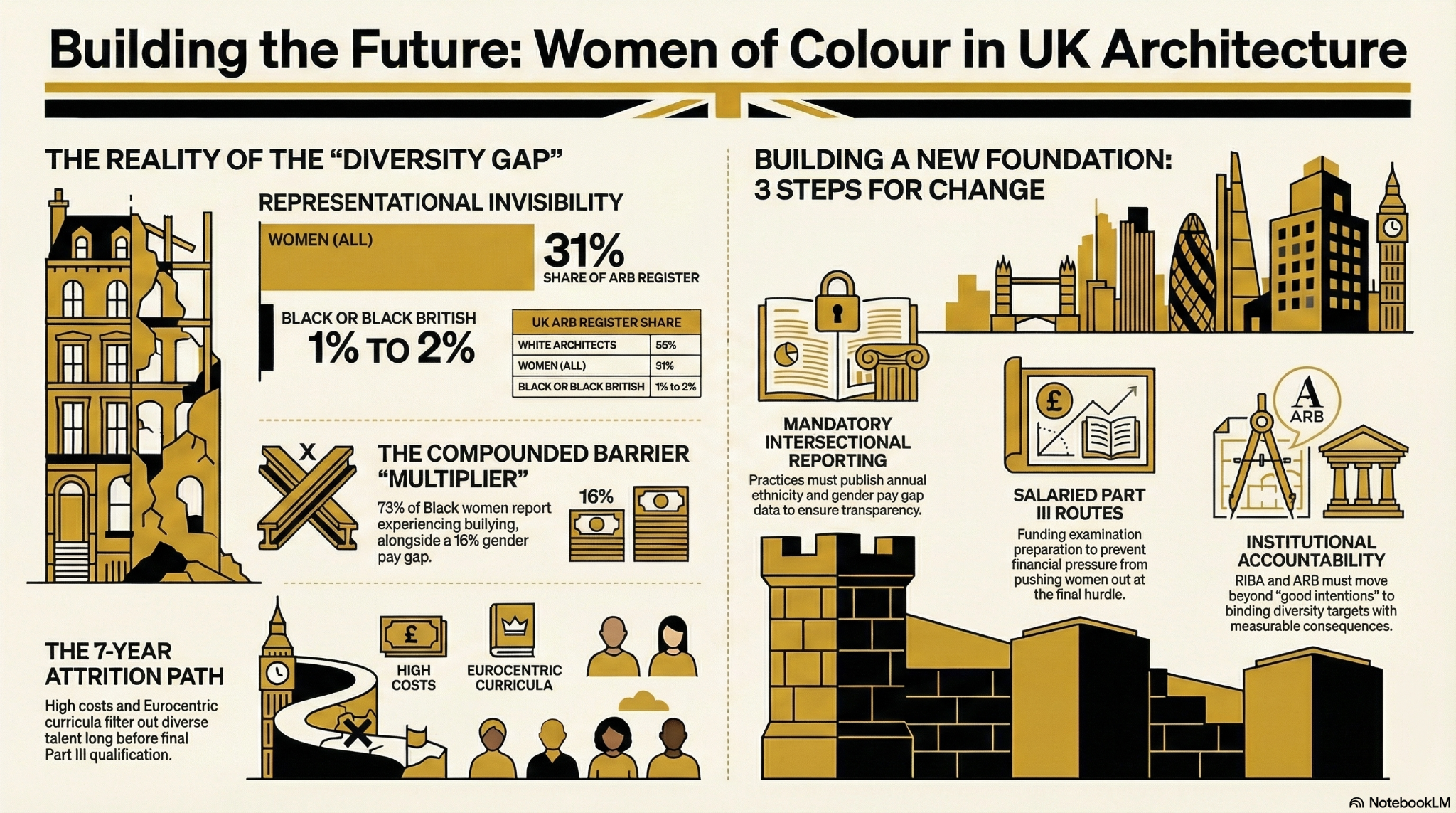
The qualification route through Part I, Part II, and Part III takes a minimum of seven years, making it one of the longest professional training pathways in the country.
Seven years of design studios, crits, professional experience log books, and oral assessments. Seven years of financial pressure and learning to defend your ideas in rooms full of people who do not always look like you.
For Black, Brown, and mixed-heritage women, those years carry a particular kind of weight that rarely gets spoken about openly.
It is not always dramatic. It does not announce itself. But it is there, quiet and consistent, in who gets heard in a design review, whose concept gets taken forward, and who gets introduced to the client.
This is not a piece about victimhood.
It is about telling the truth clearly, using real evidence and the lived experience of women who have navigated this profession with extraordinary skill. It is also about what the industry owes them and frankly, what it owes itself.
When the people designing our social housing, schools, hospitals, and public realm do not reflect the communities using those spaces, everyone loses.
The numbers tell a story the profession has been slow to confront.
Only 31% of architects on the ARB register are women despite women making up nearly 47% of new registrants and roughly half of all architecture students.
That gap between who enters and who stays is not accidental. It is structural.
Layer race on top and the picture sharpens further. Some 88 per cent of registered architects are white, compared with 83 per cent of the UK population.
Black and Black British architects account for just 1 to 2% of the register (well below their 4% share of the UK population) and 70% of those architects are based in London and the South East.
Women of colour in architecture barely register as a distinct data category.
That invisibility alone tells you something.
Here is a snapshot of where things stand:

The 2025 Fawcett Society report, Build It Together, commissioned by RIBA, makes the stakes plain:
The report's conclusion is unambiguous.
The problem is no longer a lack of evidence. It is a lack of will.

Being a woman in architecture is hard. Being a woman of colour makes it harder.
Not in a way that adds up neatly; more like a multiplier that touches every interaction, every room, and every opportunity that does or does not come your way.
The experience is not monolithic either.
Black African, Black Caribbean, South Asian, East Asian, and mixed-heritage women each bring distinct cultural contexts to a profession that frequently flattens them into a single diversity category. That erasure matters deeply.
What they do share is this:
The profession calls this a pipeline problem. Many women of colour call it something more accurate: a culture problem.
Architecture school is where the attrition begins.
Long before a woman of colour ever sets foot in a practice, the education system is already quietly filtering her out.
The Part I, Part II, and Part III route is the longest qualification pathway of any profession in the UK. It is also one of the most expensive, with tuition fees, unpaid or low-paid work placements, and living costs stacking up across nearly a decade.
For Black and Brown women, the barriers are sharper still:
The students who make it through are not the luckiest. They are often just the most resilient.
When the profession fails to provide support, women of colour in architecture have consistently done what they have always done. They have built it themselves.
Across the UK, a growing ecosystem of organisations, networks, and initiatives is filling the gaps that RIBA and ARB have been slow to close:
The emotional labour behind all of this is significant: these women are building community alongside full‑time careers, often unpaid and rarely fully acknowledged.
Data tells part of the story. People tell the rest.
Across early, mid, and senior career levels, the themes that emerge from women of colour in architecture are remarkably consistent.
Different practices, different cities, different specialisms — same experiences.
PS: The following voices are drawn from commonly reported experiences across the profession. They reflect the words of many, not one.
The profession loses extraordinary talent every single year. Not to incompetence. To exhaustion.
This conversation is not just about who gets promoted.
It is about who gets to shape the places where millions of people live, learn, work, and heal.
And right now, that power largely sits with a profession that does not reflect the communities it serves.
When women of colour are absent from design teams, their communities' needs can become invisible in the brief.
That has real, tangible consequences:
The Grenfell Tower tragedy is a painful reminder of what happens when working class and minority ethnic residents feel unheard in decisions about their own homes. The full lessons have still not been absorbed.
A growing body of research links diverse teams to more inclusive, innovative, and better performing projects.
This is not sentiment. It is increasingly backed by evidence. That makes the lack of urgency from professional leadership bodies even harder to justify.
Good intentions have had long enough.
The evidence is clear, the talent is there, and the cost of inaction (to individuals and to the profession) is no longer acceptable.
Here are 5 things that need to happen now:
The profession has the frameworks, the data, and frankly the moral obligation to act. What has been missing is urgency.
Women of colour in architecture are not asking for charity. They are asking for a profession that matches their ambition, honours their talent, and stops making them prove themselves twice over.
The built environment shapes every aspect of how we live.
The people who design it must reflect that reality.
The room is changing. But the women who deserve to be in it cannot wait any longer. The time to act is now.