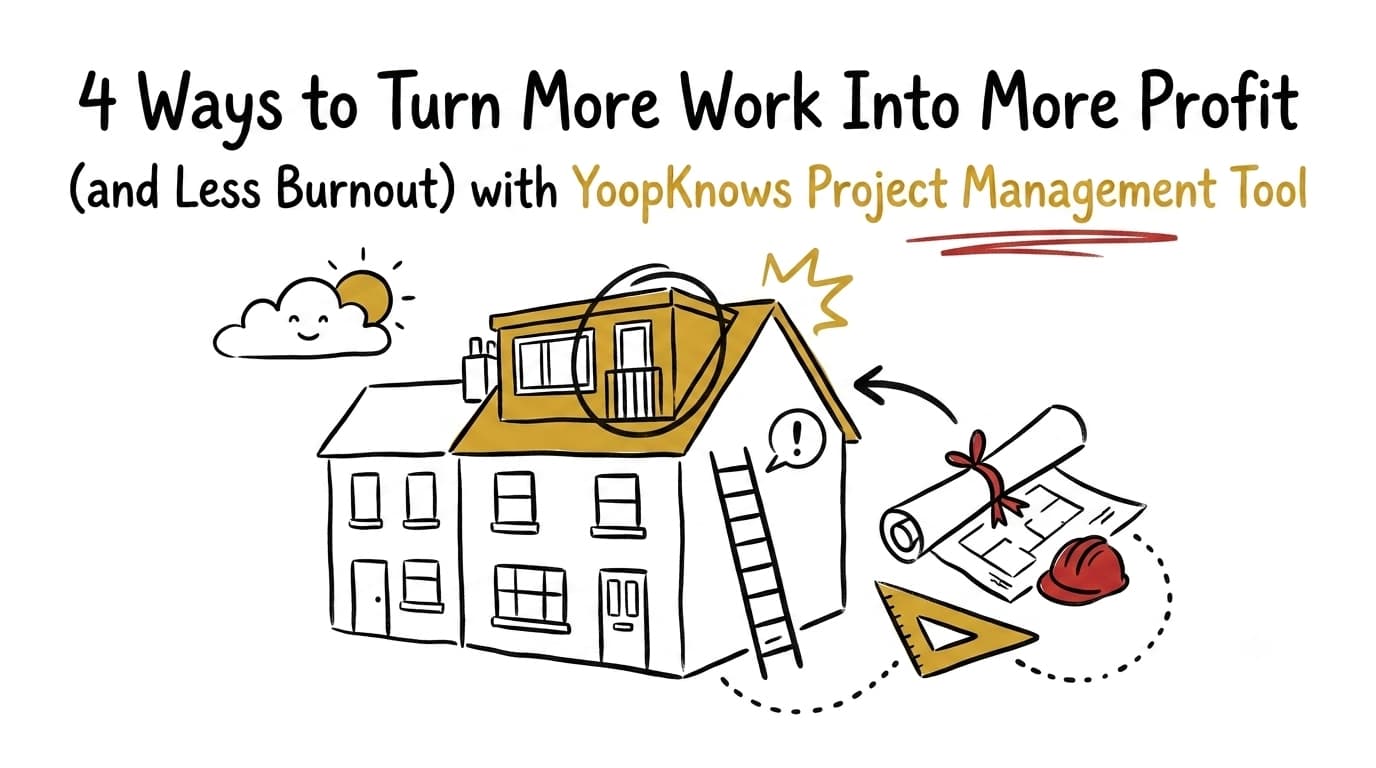
Smart Architects Are Ready for 5 Million Retrofits — Are You? Discover The Project Management Software Powering the Warm Homes Plan
Governments worldwide are racing to decarbonise existing housing stock and the UK is moving faster than most. The Warm Homes Plan puts £15 billion behind upgrading 5 million homes by 2030, placing architectural practices at the heart of the largest retrofit programme this country has ever undertaken. Tightening building regulations, rising energy costs and growing client demand are making retrofit not just an opportunity but an expectation. Yet ambition at scale demands more than great design tools. It demands airtight coordination, clear accountability and a workflow that can handle volume without dropping the ball. The practices investing in the right project management infrastructure today will not just survive the retrofit surge. They will define it.
Project management software for architects is no longer a nice-to-have — it is fast becoming the backbone of any practice that wants to work seriously in the UK's growing retrofit sector.
The government's Warm Homes Plan represents the most ambitious domestic upgrade programme in UK history.
With £15 billion committed to improving up to 5 million homes by 2030, the pressure on architects, retrofit coordinators, and design professionals to step up and deliver at scale is very real.
The question is not whether there will be enough work. The question is whether practices are organised enough to handle it.
Already, forward-thinking practices are looking hard at how they manage projects.
Tools like Rapport3, Deltek Vantagepoint, Asana, and newer purpose-built platforms like YoopKnows are gaining traction among UK architects who need more than a shared spreadsheet and a group email thread to stay on top of complex, multi-trade programmes.
The right software does not just keep a project tidy; it gives a practice the operational capacity to take on more work, with fewer mistakes and less firefighting.
The Warm Homes Plan: What's Changing and Why Architects Matter
This is the big one.
The government has committed £15 billion to retrofit up to 5 million homes by 2030. That is not a pilot scheme or a consultation exercise; it is a national infrastructure programme, and it needs architects.
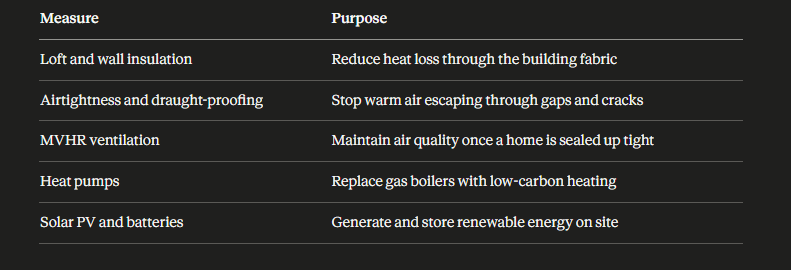
The Plan follows a fabric-first philosophy.
Fix the building envelope before adding technology.
From Stop-Start Schemes to a Long-Term Retrofit Framework
Anyone who worked through ECO or GBIS knows the frustration. Funding arrives, practices gear up, then criteria shift and the pipeline dries up overnight.
The Warm Homes Plan is structured differently, with:
A dedicated Warm Homes Agency overseeing quality, delivery and consumer protection nationally
Local authority delivery models creating regional hubs that will need consistent design and coordination capacity
Area-based programmes targeting whole streets, which makes batching and repeatable design workflows genuinely viable for the first time
Why Architects Are Central to Delivering Quality Retrofits
Retrofit done badly causes real harm — damp, mould, overheating, and homes that still fail to perform.
The Plan explicitly prioritises design quality and consumer protection precisely because transactional installs without proper design oversight have let people down before.
Architects bring:
Whole-house performance thinking — understanding how every measure interacts with the others
Moisture and thermal detailing — getting the junctions right to avoid condensation risk
Multi-trade coordination — keeping insulators, M&E engineers and installers aligned to one coherent design
The Coming Workload Wave for Retrofit Architects
5 million homes across four to five years is not an abstraction; This means Thousands of Concurrent Projects
That is thousands of overlapping live projects hitting practices simultaneously across local authority programmes, housing association frameworks and private client commissions all running in parallel.
Area-based delivery means multiple dwellings on the same street being designed and coordinated concurrently by the same team
Low-income household programmes and private loan-backed upgrades will run alongside each other with different funders and reporting requirements
More Stakeholders, More Risk, More Compliance
Retrofit involves far more parties than a typical new-build commission.
Clients, surveyors, retrofit coordinators, M&E consultants, specialist installers and funders all need clear information at the right time.
PS: Consumer protection requirements mean disputes are more likely if coordination and sign-off procedures are not properly documented throughout
Practices running retrofit projects across email threads, shared drives and WhatsApp groups are storing up serious problems.
Here is what poor coordination actually looks like on site:
Lost or superseded drawings issued to installers without version control, leading to defective works on site
Unclear responsibilities between retrofit coordinator, architect and specialist subcontractors causing critical tasks to fall through the gaps
Missed site instructions resulting in non-compliant installations that require costly remediation before handover
Duplicated effort across team members working from different information with no single source of truth
Performance gaps where completed homes fail to meet the modelled energy targets, triggering client disputes and reputational damage
What "Organised Architects" Look Like on Warm Homes Plan Projects
The best retrofit practices are not necessarily the biggest. They are the most organised. Clear workflows, visible workloads and joined-up communication separate practices that thrive from those that firefight.
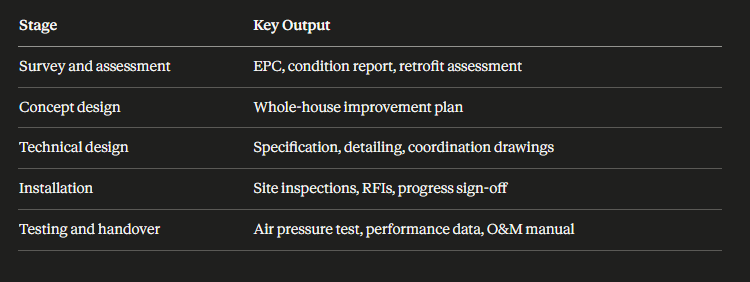
Clear Retrofit Workflows from Assessment to Handover
Every retrofit project follows a logical sequence. Organised practices map this out once, then reuse it across every commission.
Real-Time Visibility Across Projects and People
Knowing exactly which homes are at which stage and what is blocking progress without sending a single chasing email is what separates a scalable practice from an overwhelmed one.
Live project dashboards show every active commission at a glance, flagging overdue tasks before they become on-site problems
Workload visibility prevents key people becoming bottlenecks as multiple programmes ramp up simultaneously across the practice
Deadline tracking across concurrent schemes ensures nothing slips between the cracks during busy delivery periods
Joined-Up Communication Across Teams and Trades
Design decisions, site queries and change requests tied to specific properties rather than buried in inboxes keeps everyone working from current information.
Shared information environments ensure installers, coordinators and clients always reference the latest approved drawings and specifications
Site photo logs attached directly to tasks give architects and coordinators real-time visibility of progress and emerging issues
Version-controlled document issue eliminates the risk of superseded drawings reaching specialist subcontractors and installers on site
Centralised RFI management means requests for information are tracked, responded to and closed out with a clear audit trail
Why Generic Architecture Project Management Tools Fall Short for Warm Homes Plan Retrofits
Email threads, shared drives and spreadsheets simply were not built for this volume or complexity.
Fragmented project data across multiple files and inboxes creates no single source of truth for addresses, EPCs and design packs
No property-centric workflows mean generic apps cannot track retrofit stages across hundreds of individual dwellings simultaneously
Reporting to funders and agencies becomes slow and error-prone without structured, audit-ready data in one place
Workload blindspots leave practice managers unable to see who is overloaded across concurrent programmes until it is too late
Poor audit trails make it harder to demonstrate design intent, installation quality and sign-off compliance against Warm Homes standards
YoopKnows as the Best Project Management Tool for Retrofit Architects
Practices that have outgrown spreadsheets and email need a purpose-built environment.
YoopKnows sits alongside tools like Rapport3 and Deltek as a serious option for retrofit-focused practices needing real operational control.
Why It Works in Practice
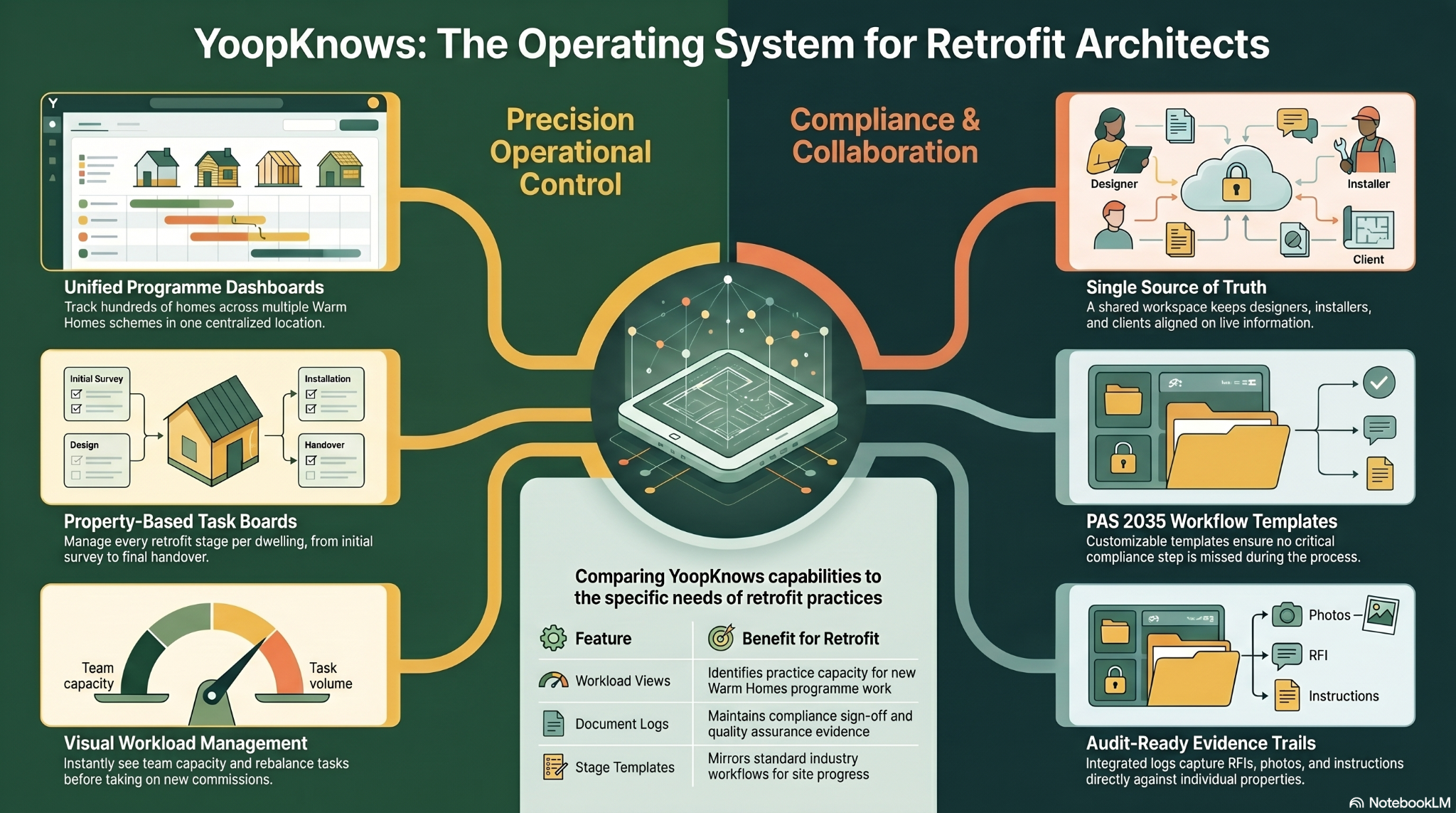
One central workspace replaces scattered email threads, giving every team member a single source of truth across all live commissions
Customisable retrofit stage templates mirror standard PAS 2035 workflows so no critical step is missed before works proceed on site
Visual workload management shows practice managers exactly where capacity exists before taking on additional Warm Homes programme work
Integrated site communication logs RFIs, photos and instructions directly against individual properties keeping the audit trail clean and complete
Practical Steps for Architects to Prepare for the Warm Homes Plan Wave
The wave is coming.
Practices that prepare now will have a genuine advantage over those scrambling to organise mid-programme.
Step 1: Map your current retrofit workflow by documenting every tool, handoff and bottleneck across your practice to identify where commissions consistently stall
Step 2: Pilot YoopKnows on one manageable local authority batch, setting up project stages, templates and team roles before migrating all communication and tasks across
Step 3: Standardise reusable templates for common retrofit scopes including insulation only, insulation plus heat pump and deep retrofit, aligned to Warm Homes documentation and reporting requirements
Step 4: Roll out across your wider team and supply chain, using live dashboards to track programme progress and report confidently to clients, funders and the Warm Homes Agency.
Turning the Warm Homes Plan into an Opportunity, Not Overwhelm
The Warm Homes Plan is the biggest retrofit push in UK history.
£15 billion. Five million homes. A hard 2030 deadline.
For architects, that is not a distant policy ambition; it is a live commercial opportunity arriving on your doorstep right now.
Disorganised practices will struggle, facing overloaded teams, performance gaps, compliance failures and the kind of reputational damage that is hard to recover from in a relationship-driven sector
Organised practices will grow, winning more commissions, delivering better outcomes and building the systems needed to sustain high volumes of quality retrofit work over the long term
The right project management software makes the difference, and platforms like YoopKnows give retrofit architects the operational backbone to manage multiple live programmes, coordinate trades and report confidently to clients and funders
The Warm Homes Plan does not have to mean chaos.With the right tools and workflows in place, it can be the making of your practice.


.png)