.png)
In May 2026, RIBA sent a clear signal to every architecture practice in the UK: the era of "anyone can do it" is over.
The professional body published proposals for a new Built Environment Services Bill that would introduce criminal penalties for unqualified individuals carrying out restricted design activities — and establish a new Built Environment Council to enforce it.
So here's the question every principal and practice director needs to sit with: if a regulator, insurer or client asked you to prove who did what on your last project — could you?
Project management software for architects is no longer just a productivity tool. In the context of this shifting regulatory landscape, it's becoming the backbone of how compliant, well-run UK practices protect themselves — and their clients.
Many practices already rely on tools like Deltek Vantagepoint, Rapport3, Synergee or Asana to manage their project workflows.
Others are increasingly turning to newer platforms such as YoopKnows, which has been built with the structured, traceable workflows that architecture and construction projects specifically demand.
The question isn't just which tool your practice uses; it's whether the tool you're using actually captures the kind of evidence trail the new regulatory framework will require.
In this article, we'll walk you through exactly what audit-readiness looks like under the new framework, where most practices are currently exposed, and how the right project management software (like YoopKnows) can help you get ahead of it without overhauling the way your team works.
Most principals we speak to are across the headline changes.
The detail, though, catches people out.
RIBA's proposals would formally reserve safety-critical tasks to demonstrably competent chartered professionals, backed by criminal penalties.
That changes the stakes considerably.
Your inbox was never designed to carry that responsibility. Neither was WhatsApp.
And yet, for most practices, that is precisely where the evidence trail lives: buried in threads, personal accounts and group chats that nobody can search quickly when it matters most.
The tasks most likely to fall under reserved activities include:
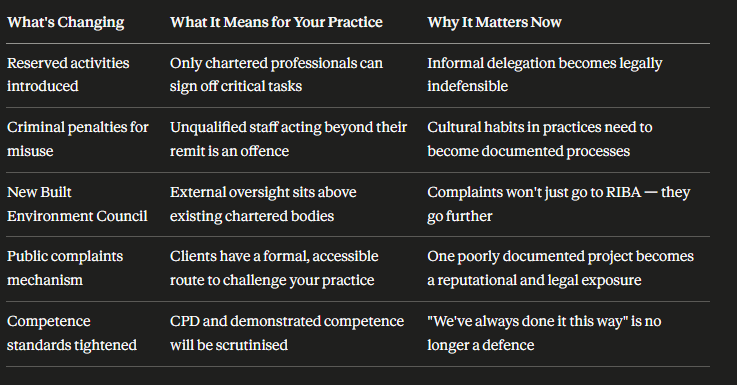
The good news?
The right project management software for architects handles both simultaneously.
The difference lies in how deeply the tool embeds accountability into everyday workflows; not as an add-on, but as the default way work gets recorded and signed off.
From "Anyone Can Do It" to Clearly Reserved Activities
This is the shift that will catch practices off guard.
Right now, there is no legal requirement for the person submitting a planning application to prove they are competent.
That is about to change.
Restricted activities will be limited to chartered professionals who consistently meet competence standards and practices will need to demonstrate that, formally.
Good intentions won't satisfy a regulator.
For every critical submission, your practice needs to answer four questions cleanly:
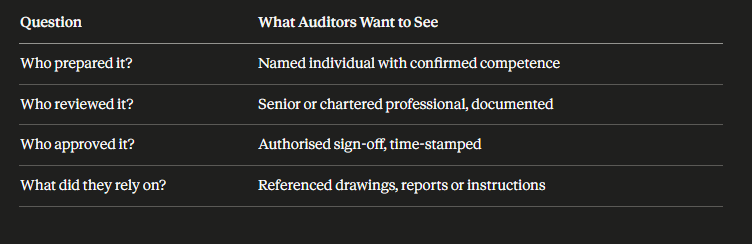
A regulator, insurer or client won't wait three days while someone reconstructs an email thread.
Audit-readiness means retrieving a clear, chronological project story within minutes; calmly and confidently, not scrambling under pressure.
That distinction is what separates a well-run practice from an exposed one.
The most common evidence gaps practices face:
In many practices, who "can" sign off a fire strategy or submit a planning application is more cultural than documented.
Everyone broadly knows, but nothing is written down. Under a competence-led, offence-backed framework, that informality becomes a genuine legal exposure.
Drawings on the server, notes in email, approvals in chat — no single place tells the complete project story.
That fragmentation causes errors, duplicated effort and missed steps.
More critically, it weakens your position significantly if your practice is ever challenged.
[Read: How Architects Can Stop Drowning in Projects: Smarter Workload Management for the 2026 Construction Boom]
Think of YoopKnows as your practice's single source of truth — the place where every task, discussion, file and approval lives together, tied to the specific project it belongs to. No more hunting across servers and inboxes.
Each project workspace automatically builds a live log as your team works:
YoopKnows lets you define roles clearly (chartered architect, Principal Designer, technical lead, assistant) and explicitly assign restricted activities to authorised people only.
No ambiguity, no cultural assumptions. Just clear, retrievable evidence of who was responsible for what.
Running several live projects simultaneously is where things typically unravel.
YoopKnows gives principals a dashboard view across all active jobs, flagging compliance-related tasks and keeping consultant inputs, site RFIs and client instructions logged against the right project — so nothing slips between teams.
The practices that handle regulation well don't scramble at the end of a project — they build the right habits in from day one.
YoopKnows lets you create project templates that mirror your standard workflows for planning, building regulations and safety-critical tasks, with mandatory checks and sign-off steps embedded from the start.
Tasks in YoopKnows can be configured so they cannot be marked complete until the designated competent reviewer has approved them.
That single feature alone closes one of the most common compliance gaps in busy practices.
When your team uses YoopKnows as their default working environment, the evidence trail builds itself.
No end-of-project scramble, no reconstructing decisions under pressure; just a continuous, time-stamped record of who did what and when.
This doesn't have to be a big overhaul.
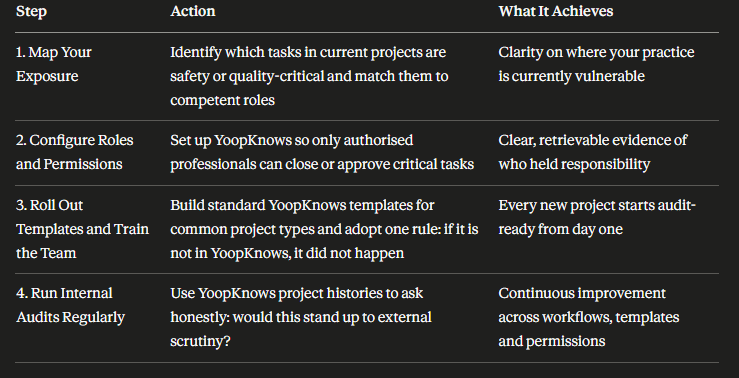
Most practices get there in four (4) straightforward steps and the shift in how your team works is smaller than you'd expect.
Here is exactly how to get started:
The regulatory direction is clear and it is not reversing.
Criminal penalties, stricter competence expectations and a formal public complaints mechanism are coming and practices that are unprepared will feel it first.
The good news is that compliance and productivity are not in conflict.
With YoopKnows as your project management software for architects, audit-ready projects become your default, not your exception; turning tougher rules into a genuine competitive advantage.