A project management tool for architects can be the difference between a summer that pays off and one that quietly burns your team out.
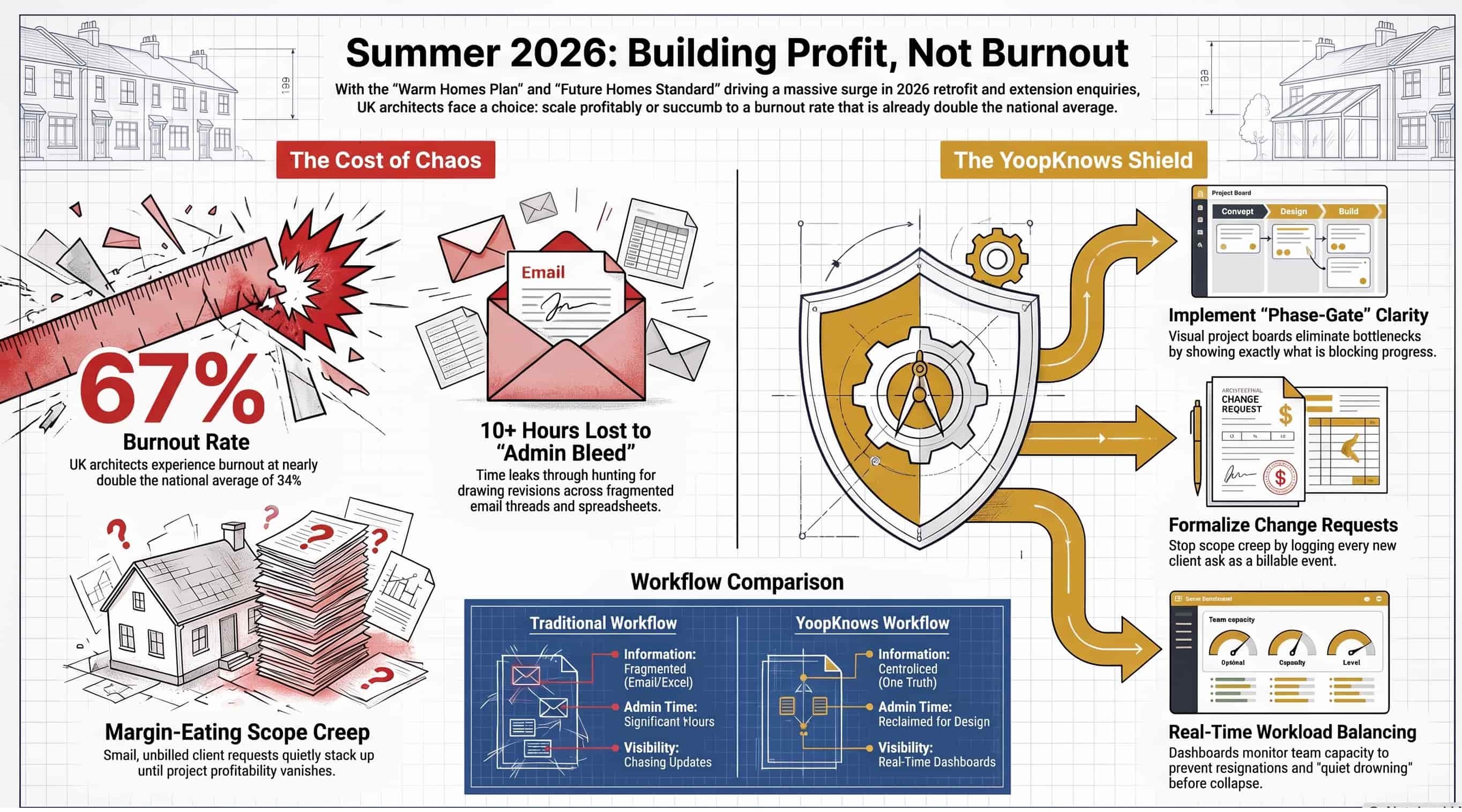
The Warm Homes Plan and the Future Homes Standard are reshaping how homeowners think about upgrades, and enquiries for loft conversions, extensions, and retrofit work are climbing fast this summer 2026.
So here's the question worth sitting with right now: is your practice actually set up to handle more work, or just more chaos?
Because most of us know exactly what "more work" tends to look like in practice.
It's another spreadsheet nobody quite trusts. It's a drawing revision sitting in three different email threads, and nobody's sure which one's current.
It's a site visit that gets bumped because the person who was meant to chase the structural engineer got pulled onto something else.
None of it is dramatic on its own but a few weeks of it, and you've got late nights, missed fee opportunities, and a team quietly running on empty.
A recent study reveals that 67% of architects experience burnout, compared to a 34% national average and 47% pointed to long hours and poor work-life balance as the main cause.
That's not a "some people are struggling" statistic.
That's a whole profession running too hot.
Practices juggling several jobs at once (each with its own drawings, deadlines, and client back-and-forth) know how fast things slip without a proper system.
That's where a tool like YoopKnows starts to earn its keep, turning a hectic season into a genuinely profitable one.
Right, so you know the problem.
More enquiries, more sites, more drawings flying about, and somehow less time to actually do the work you trained for.
The good news is none of this is unfixable.
It's not about working harder or hiring five more people you can't afford. It's about closing the gaps where hours, money and sanity quietly leak out of a busy practice.
Here are four (4) ways the best project management tool for architects like YoopKnows helps you do exactly that, starting with the one almost every practice underestimates.
Ask any architect where their week actually goes and admin will come up before design does. Not because anyone chose it that way. It just happens.
You start the day meaning to sketch a section detail, and somehow you're three emails deep trying to find the latest floor plan revision, or updating a spreadsheet that four people have already touched and none of them agree on.
This is what practices call admin bleed.
It's not one big time sink. It's dozens of small ones that quietly eat your week without you noticing until Friday, when you realise you billed fewer hours than you actually worked.
To make this a bit more concrete, here's a simple breakdown of where those hours typically come from and what tends to change once things are properly centralised.
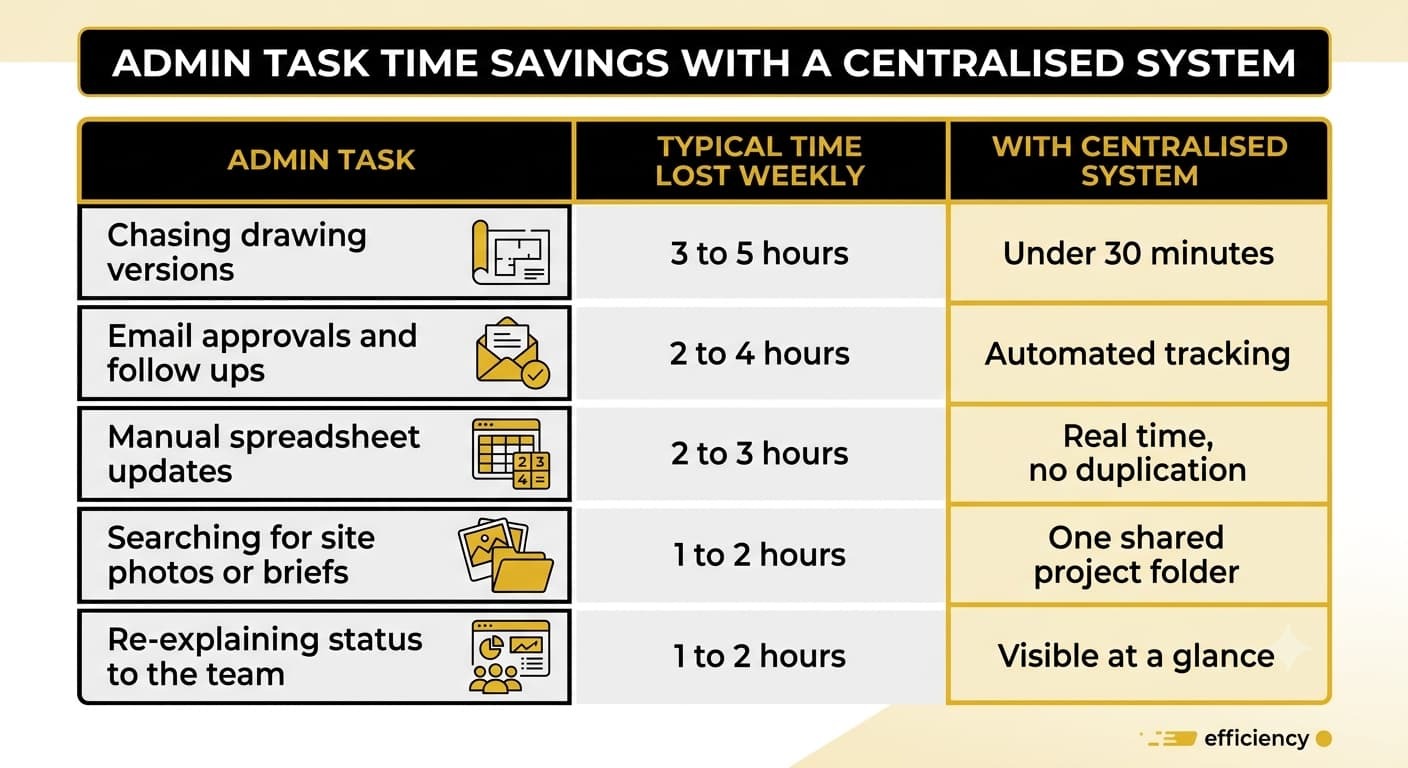
A project management tool for architects like YoopKnows tackles this by pulling drawings, briefs, site photos and client notes into one place, so nobody's hunting for information that already exists somewhere in the practice.
Those recovered hours don't disappear.
They shift back to design, which is where the fee actually gets earned, and where most architects would rather be spending their time anyway.
2. Kill Scope Creep Before It Eats Your Margin
Every architect knows this client.
Lovely to work with, genuinely, until the "just one more thing" starts creeping in. A slightly bigger window here. A different staircase there.
None of it feels like a big ask on its own, which is exactly why it's so dangerous. Scope creep rarely announces itself. It just quietly stacks up until you look at your fee and wonder where half the hours went.
Summer makes this worse. Teams are stretched thin, everyone's moving fast, and there's rarely time to stop and ask, is this actually in scope, or are we just being helpful?
This is where structure earns its keep.
With clear task templates and a proper change request workflow inside YoopKnows, every new ask gets a moment of pause. It either gets logged as billable, or it gets formally approved before anyone touches it.
Here's an illustration of how common scope creep triggers get handled once that structure is in place.

The upside works both ways.
Clients get clarity on what's included and what isn't, and your team gets a boundary they don't have to enforce personally, because the system does it for them.

Every practice has felt this one.
A project stalls, not because anyone's slacking, but because nobody's quite sure what's waiting on what.
Drawings can't go out until the structural calc lands. The structural calc is sitting in someone's inbox, waiting on a reply nobody's chased yet. Days pass.
Suddenly a deadline that felt comfortable a fortnight ago is now a genuine scramble.
This is the bit that rarely gets talked about honestly.
Most bottlenecks aren't about workload. They're about visibility. Nobody can move fast on something they can't see coming.
YoopKnows tackles this with a project board that lays out work progress clearly, showing who's in charge of what and what needs to happen next, so the whole team can see what's blocking what without having to ask around.
Here's how that clarity tends to play out across a typical project.

The productivity gain here is quieter than it sounds, but it adds up fast.
When everyone can see the board instead of asking around for updates, less time gets spent checking in, and more time goes into actual work.
And that saved time isn't just about hitting deadlines sooner.
It buys back breathing room, the kind that lets a team finish a phase without the usual last-minute scramble, and go into the next one without already feeling behind.
Faster clarity means faster turnaround, and faster turnaround means invoicing happens sooner rather than chasing a project that's dragged on longer than it should have.
Here's the thing about overload. It rarely shows up as one person shouting for help.
More often, it looks like someone quietly saying yes to one more task, then another, until they're the person everyone leans on and nobody notices they're drowning until they've already burnt out or handed in their notice.
This isn't a small issue either.
Remember that 47% figure from earlier, the one about long hours and poor work-life balance being the main driver of burnout among UK architects.
That's not happening because people don't care about their work. It's happening because nobody's watching workload in real time until it's already too late to fix quietly.
YoopKnows helps here with dashboards that show who's carrying what, across every live project, so overload gets spotted before it becomes a resignation letter.

The profit case is straightforward.
Losing a skilled architect to burnout costs far more than the salary alone, once you factor in recruitment, training and the projects that stall in between.
The well-being case matters just as much. A team that isn't running on fumes does better work, and stays around long enough to see the next busy season through without dreading it.
Every practice will get through summer 2026 one way or another.
The real question is what it costs you to get there.
Do it the old way, and you're looking at missed deadlines, clients chasing you for updates, and a team running on fumes by August.
That's how good architects quietly walk, and how burnout stops being a statistic and starts being someone on your team.
YoopKnows isn't just another tool sitting on top of your workflow.
It's a profit multiplier and a burnout shield, built for practices who'd rather work smart than white-knuckle through the season.
So before the rush hits properly, take a proper look at how your practice actually runs. Then let YoopKnows turn more work into more profit, and a lot less stress.