.png)
YOOPknows RIBA stage tracking is the kind of thing you start googling at 9pm on a Sunday, after a week that didn't go to plan.
Since September 2025, when the Architects Registration Board's revised Code of Conduct came into force, the bar for proving competence and accountability has quietly risen and with a Single Construction Regulator on the way, it isn't coming back down.
So ask yourself honestly: if a client or your insurer rang tomorrow and asked exactly which RIBA stage a project was at, and whether the fee still matched the work, could you answer in thirty seconds?
Or would someone have to dig through inboxes and a spreadsheet nobody's touched since March?
If it's the second one, you're not alone, and it's not really your fault.
Most directors didn't get into architecture to become project administrators. But generic task boards and endless email threads have a way of quietly turning you into one anyway and every hour spent untangling who's doing what at which stage is an hour you're not billing.
This is exactly the gap that's pushed a growing number of UK practices toward YOOPknows: project management software built specifically to track work against the RIBA Plan of Work stages (0–7), so the structure that protects your fees and your compliance is just there by default, instead of something you have to bolt on yourself.
Most directors have tried it.
You sign up for Monday or Asana, spend a weekend building boards that vaguely resemble RIBA stages, then watch the team quietly abandon them by week three because nothing maps cleanly onto how a UK practice actually works.
The bigger issue hides underneath that frustration:
Here's what phase bleed actually looks like on a typical project:
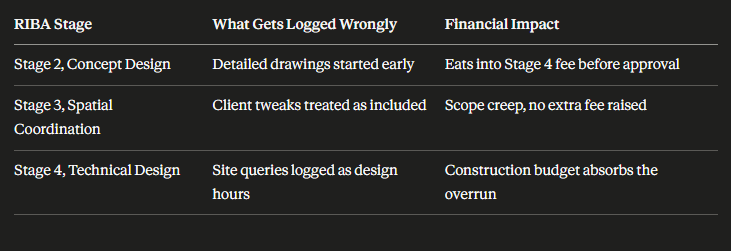

Picture your dashboard for a second.
Not a wall of identical-looking cards, but every live project sorted exactly where it sits in the RIBA Plan of Work, Stage 0 through to Stage 7, visible at a glance.
Anyone who's run a practice through a tricky multi-project month knows how rare that clarity actually is.
That's the visual job board in practice.
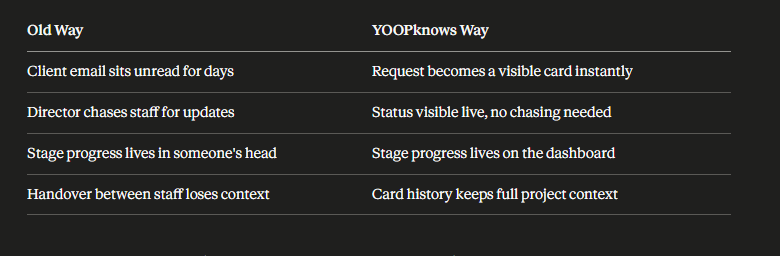
No more opening five different files to figure out who's where, and no more relying on memory to know what's overdue:
Email chaos disappears the same way. Client requests become visual cards inside the relevant stage, not buried in someone's inbox waiting to be forgotten until it's too late.
Every director has had that gut drop moment, checking the books mid project and realising the Technical Design stage has burned through half its fee before planning's even been submitted. By then it's usually too late to fix.
YoopKnows catches it earlier:
Capacity planning usually happens in someone's head, until the week a milestone shifts and the whole schedule quietly falls apart underneath it.
YoopKnows handles that reshuffling automatically:
Here's how the numbers actually stack up when you're choosing between YOOPknows and the older, generic alternatives most practices already have lying around.
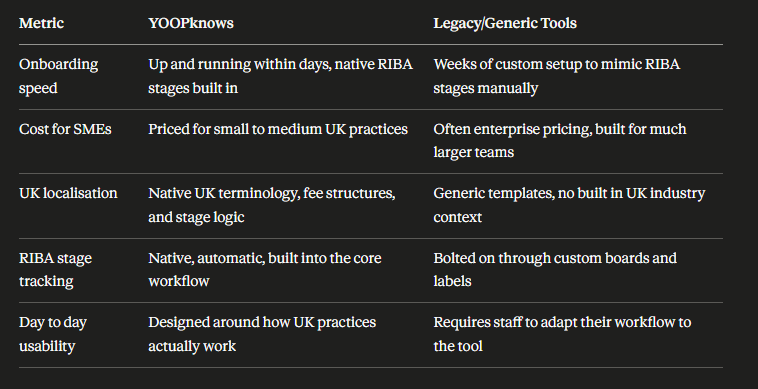
If your practice is haemorrhaging billable hours to admin overhead, the fix isn't another generic board, it's software built around how UK architecture actually runs.
RIBA stage tracking shouldn't be something your team manually maintains, it should just be there, working quietly in the background.
YOOPknows was built by a practising UK architect for exactly this reason.
If you're tired of chasing updates and guessing at fee burn, it's worth a proper look at the YOOPknows dashboard.